Fun branch activity eating "tapioca" (Brazilian crepes) made by the sisters at a branch activity. Tapioca (Portuguese pronunciation: [tɐpiˈɔkɐ]) is a starch extracted from cassava root (Manihot esculenta). This species is native to North Region, Brazil but spread throughout the South American continent. The plant was carried by Portuguese and Spanish explorers to most of the West Indies, and continents of Africa and Asia, including the Philippines and Taiwan. It is now cultivated worldwide.


Branch member drinking Chimarrão. According to Wikipedia: Portuguese: [ˈmatʃi]; sometimes spelled maté in English, but never in Spanish or Portuguese), also known as yerba mate, chimarrão (Portuguese: [ʃimɐˈʁɐ̃w̃]) or cimarrón (Spanish: [simaˈron]), is a traditional South American caffeine-rich infused drink, particularly in Argentina (where it is defined by law as the "national infusion"[2]), Uruguay, Paraguay and Southern Brazil, and to a lesser degree in southern Chile, the Bolivian Chaco, Syria and Lebanon. It is prepared by steeping dried leaves of yerba mate (Ilex paraguariensis, known in Portuguese as erva-mate) in hot water.
Mate is served with a metal straw from a shared hollow calabash gourd. The straw is called a bombilla in some Latin American countries, a bomba in Portuguese, and a bombija or, more generally, a masassa (type of straw) in Arabic. The straw is traditionally made of silver. Modern, commercially available straws are typically made of nickel silver, called alpaca; stainless steel, or hollow-stemmed cane. The gourd is known as a mate or a guampa; while in Brazil, it has the specific name of cuia, or also cabaça (the name for Indigenous-influenced calabash gourds in other regions of Brazil, still used for general food and drink in remote regions). Even if the water is supplied from a modern thermos, the infusion is traditionally drunk from mates or cuias.

Caju fruit in a member's back yard. Easy to grow, fruit and juice are wonderful, caju (cashew) nut delicious!

Pineapple plant in the same back yard.

Family whose back yard contains the above and other wonderful fruits, herbs, and vegetables.

Missionaries assigned to Sorriso. From left to right: Elder Araujo from north Brazil, Elder Nere from Natal, Brazil, Elder and Sister Romrell, Elder Weeks from Georgia, and Elder Rivera from Peru.

Nelson preparing fresh coconut from his yard.

Being entertained by Nelson and Juliana in their wonderful back yard. Vicente (2nd Counselor in Branch Presidency and his younger brother, Victor) on the right. Vicente has only been home from his mission a few months.

Fresh coconut water

Mission Financial Secretary and Executive Secretary buying things for the apartment for 2 sister missionaries. Elder Bonaro and Elder Tavares. These are the same two who furnished our little "kitchenette."

Side trip to Feliz Natal (Happy Christmas). On the way we stopped in a wonderful town called
"Vera." Fascinating because that is my mother's name.

View along the road.

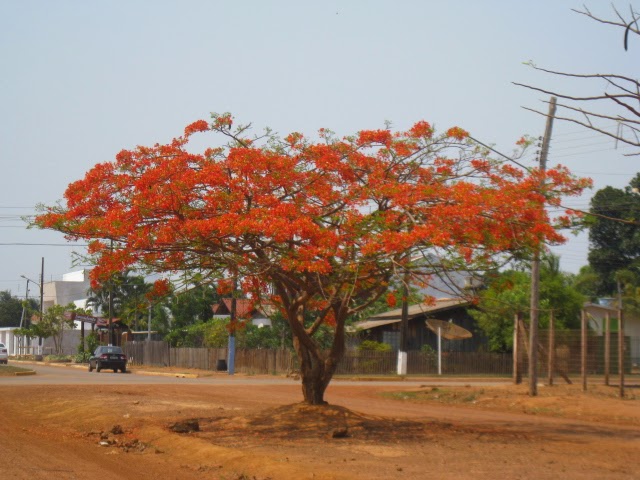
Wonderful flowering tree in Vera. Not an unusual site in Brazil.


Lot's of log hauling along this road. We were happy to pass this truck safely.

Colorful Catholic Church in Vera

Cemetery in Vera. Each house a little shrine for the deceased. Probably more for the rich.

Burial shrine up close.

Popular past-time in Vera park where young teens sit and ride their skateboards down an incline.

More from Vera

A little European flavor


Rich, rich farmland in the state of Mato Grosso. I love these farm scenes!!!


From the air you can see how flat the land is--ideal for rich crops.